Wednesday, September 4, 2013
Passing Messages On Is Important
This is one of the trails for my new series that are currently being shown on Dave and other UKTV channels. There are four in total - well, more if you count the short and long versions - but there are four set ups. I can always tell when one's gone out because I get a few tweets from people. So far they've all been lovely and it's especially pleasing when someone's been caught out for a second and thought they were watching a real ad.
But, while I'm obviously keen to pass on the message that the series starts on Tuesday, September 17th, that's not the message I'm referring to in the title of this post.
Before we filmed these, there were various meetings in which the details were finalised. There was one script for this trail where it described the model as being "in a bikini". I always feel uncomfortable watching comics do "ironic" things that involve "totty". There has to be a really good justification for someone being a state of undress or it just looks like an old man has come up with a feeble excuse to hang around with someone youthful and nearly naked. So I said as much, and everyone agreed that a towel would be more appropriate. If anything it accentuates the difference between the glamour of the close up shot used for the "ad" and the prosaic reality you see when I've, um, "interrupted".
So the script was changed. And that's the message that should have been passed on. Because someone, somewhere had the job of casting these ads. And they had to meet various, young actresses. And they were still working from a script that involved an actress in a bikini. Because nobody had passed on the message. If you're casting someone for a gig that involves wearing a bikini, it makes sense that you have to see them in their bikini. Or their underwear. Or whatever. And so, apparently, that's what happened. With various potential-shampoo-ad-models.
I wasn't there. I've never even met the person responsible for the casting. But the women involved must be thinking he was a right old perv. Especially, Ashleigh who got the gig. Imagine doing a casting where you're asked to strip down to your skimpies, getting the gig and then discovering that it was completely unnecessary and not required for the part!
My apologies to all concerned. The casting director wasn't a perv. Or at least, if he is it's a coincidence. It's just that the message didn't get passed on.

Tuesday, August 20, 2013
Dave On Dave Action, Coming Soon.

This is what the press release says:
Dave Gorman thinks modern life is good...ish. However, tired of endlessly being sold stuff he doesn't need, feeling manipulated by the media and harassed by technology, he’s become slightly obsessive about the 'ish'.And that's nice.
But instead of letting it drive him mad he's decided to fight back. A bit. Sort of. Ish. So he’ll be sharing his observations and venting his frustrations in six mischievous shows for Dave. Presented using his own unique blend of stand-up and documentary comedy, expect a whole new take on the things we normally take for granted.
Whether it’s idiocy on the internet, ill-thought-out technological solutions, unquestioned advertising logic, online ‘news’, one-click agreements to pages of terms and conditions, the cult of celebrity, Lord Sugar, the new Blister Pack Economy, or even (somewhat distressingly) discovering exactly where on the A-Z lists of fame he resides, Dave does what we don't: he stops and actually looks at things. And asks questions. And judging by some of the things he discovers, perhaps the people churning this stuff out ought to stop and look at what they're doing from time to time too. Because there's a hell of a lot of it that makes no sense at all.
The new series is loosely based on Dave Gorman’s internationally critically acclaimed live show, Powerpoint Presentation, which went on a three-time-extended nationwide tour of the UK including multiple London dates at the Hammersmith Apollo and the Queen Elizabeth Hall at the Southbank Centre.
Join Dave, on Dave, for a journey of intellectual curiosity and a healthy amount of humour as he holds up a mirror to the countless questionable things we’re all exposed to but just seem to accept as ok.
Thursday, July 25, 2013
Putting A Name To The Face
I travelled into town yesterday, for the first time in a while, and this poster was all over the tube.
 Now I know that the order in which the names appear on the poster is all to do with egos, star billing, and all sorts of important negotiations but every time I see a poster like this, with the cast lined up but with the wrong names floating above their heads I just think it looks like someone's done really badly in a pub quiz.
It just looks like the people responsible for marketing the film don't know which actor is which. And they're really bad at guessing. Someone should just take each of them aside and have a word. "Look, Bruce. I know you've got star billing and that means your name has to come first and all that... but because you're the star, we also want you in the middle of the poster and it's making us look a bit, y'know... stupid..."
It's obviously a composite photo - which explains why it appears with the stars in a slightly different order in other versions... like this one...
 ... where they've accidentally scored one out of seven by placing Mary-Louise Parker underneath her own name. In this one they also give Anthony Hopkins a completely different head. But no handcuffs.
 It may be something to do with the way the poster has been pasted on to the curved wall of a tube station, but the faces look pretty badly photoshopped too.
I mean, those do look like Bruce Willis's features, and it does appear to be his head... but I'm not convinced they're lined up with one another as they are in the real world.
It looks to me as if his features have been dropped in just a little too low and to the left.
Either that or he's had one of those rare Hollywood face-drops people are never going on about.


And as to Catherine Zeta Jones... well, the last time I saw a head meet a neck like that I was playing Cluedo.
So... knowing that the marketing team for Red 2 aren't averse to a bit of shonky photoshopping, I corrected the whole poster and put the right faces with the right names. I'm only trying to help.


It just looks like the people responsible for marketing the film don't know which actor is which. And they're really bad at guessing. Someone should just take each of them aside and have a word. "Look, Bruce. I know you've got star billing and that means your name has to come first and all that... but because you're the star, we also want you in the middle of the poster and it's making us look a bit, y'know... stupid..."
It's obviously a composite photo - which explains why it appears with the stars in a slightly different order in other versions... like this one...

 It may be something to do with the way the poster has been pasted on to the curved wall of a tube station, but the faces look pretty badly photoshopped too.
I mean, those do look like Bruce Willis's features, and it does appear to be his head... but I'm not convinced they're lined up with one another as they are in the real world.
It looks to me as if his features have been dropped in just a little too low and to the left.
Either that or he's had one of those rare Hollywood face-drops people are never going on about.


And as to Catherine Zeta Jones... well, the last time I saw a head meet a neck like that I was playing Cluedo.
So... knowing that the marketing team for Red 2 aren't averse to a bit of shonky photoshopping, I corrected the whole poster and put the right faces with the right names. I'm only trying to help.

Monday, July 8, 2013
Angela Lansbury Forever
On Saturday morning I saw this tattoo on a man's leg.
I have a regrettable tattoo on my left arm. I used to feel haunted by it. Nowadays I rarely give it much thought. But on Saturday morning I spent a few moments thinking, "it could be worse... I could have a tattoo of Angela Lansbury from Murder She Wrote on my leg."
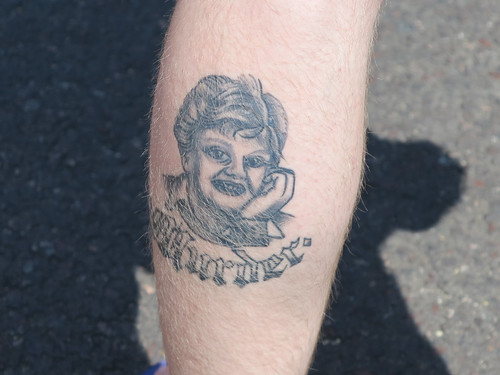
I have a regrettable tattoo on my left arm. I used to feel haunted by it. Nowadays I rarely give it much thought. But on Saturday morning I spent a few moments thinking, "it could be worse... I could have a tattoo of Angela Lansbury from Murder She Wrote on my leg."
Friday, June 14, 2013
Faintly Ridiculous

The series is six episodes. Each episode is an hour long. That's a TV hour - so it's a little less when you make way for some commercials and so on but even so, that's like putting six different Edinburgh shows together.
In the late 90s, when I was first wrestling with the concept of one-man-shows and particularly with how to make one feel like a show and not just a collection of bits and pieces, I wouldn't have believed it possible to work on six of them concurrently. But weirdly, in the time that's passed, I've got better at doing that, than I am at doing short sets. These days, writing an hour is sort of easier than writing ten or twenty minutes for me. A short set seems unsatisfying because you can't weave stuff back in. It can't really be as cohesive.
With this series we've filmed two episodes in a night. We don't do that just because it's cheaper - although that definitely helps - it's also because it suits the way we want to make the show. And I enjoy the energy of performing. I prefer doing it that way.
TV-people normally like to record loads of material and then edit it down - the idea being that, that way, they get only the very best stuff. But it ignores the fact that, in a show, all the stuff is connected. It isn't a series of discrete, individual elements that can be assembled in any order and with any cuts you like. A particular sentence might have got the biggest laugh of the night... but if you take away the four sentences that preceded it and the one five minutes earlier that planted a fact in the audience's mind that's come back to hang around in the shadows of the later joke... then it just won't be as funny. And the laugh it got on the night will sound odd on the TV because the live audience wasn't just laughing at those words... but at those-words-in-that-particular-context.
I don't like the idea that the recording is where you create all the different elements but that the edit suite is where you build the show. So we set out to build the show first. Which is why I did a lot of dry runs of the show live in advance of the recordings. And I'm very grateful to the venues and audiences in Windsor, Fareham and Tring for making that possible. Doing the show, then changing it, then doing it again and then changing it and then doing it again and then... - you get the idea - means you find out so much more about the material than you ever will do by having a meeting.
And, if we got it right, it meant we'd be able to make shows that flow in the same way that live shows do. We could record about an hour in a way that had a beginning, a middle and an end and nobody would ever have to say, "can you rephrase that bit because it won't make sense if we have to cut the first part". Because we knew weren't going to cut the first part. Or any part. Because we'd already made sure that things worked and fitted together in the right kind of time.
But a consequence of that is that there isn't much slack in the system. We don't have a lot of spare time for any retakes... so if something goes wrong, we're up against it. And on Tuesday - our final recording - things wanted to go wrong.
For some reason the projection started to flicker and black out on Tuesday. It started during the first show and then appeared to be fixed. Then I started to flicker and black out too. Literally. There's at least one Found Poem in each show. They're silly moments of cod-seriousness and I tend to end them with an over the top bow and a silly, theatrical flourish. At the end of the first Found Poem on Tuesday as I took that silly bow my vision blacked out. It sounded like I was in an echo chamber and I felt my knees buckle. I tried to stand up and carry on, my vision didn't return and I felt as though my speech was slurred. So I had no choice but to stop and tell people I'd nearly fainted. Which is, I think, what had happened.
Producers came to see me as my eyes and ears adjusted. They offered me a break. But I didn't want to take one. And I didn't really want the audience to know how bad I was feeling. Because an audience wants to relax. An audience wants to trust that a performer is in control and that everything's going to be okay. It's harder to laugh if, at the back of your mind, there's a worry that the guy doing the talking might fall over. It adds a new context to things. It isn't helpful. On top of that, a big break could run the risk of disconnecting the material that has to be connected.
And besides, we don't actually have that much spare time in our schedule. So we carried on. Yesterday I saw some footage from the show. I was expecting to see an ashen-faced, hollow-eyed figure saying the words. But I looked alive. And the audience were completely switched on.
In the break between the two shows there was panic in the eyes of the production team. Water was drunk. Bananas were eaten. I hadn't had any dinner that day so a cheese sandwich was provided. But the bite I took came straight back up.
"Sit with your head between your knees." "Lie down with your feet in the air." "Drink more water." "It's very hot in here, let's take him outside for some fresh air." "Do you think you're going to throw up?"
That's kind of how the interval went. The second show started fine. But then, less than ten minutes in, the projector failed again. On tour I take my own kit. I know what the back up plans are and I've never had to cancel a show because of a failed projector or laptop. I'm very belt and braces about these things - it's what I do for a living after all. But for the series we've hired in a different projector. It's still my laptop and I've still made all of the stuff that's on it (and yes, it's still made in Powerpoint) but the projector and the screen are hired in because there are issues with projection on TV that you don't have to contend with live. Hotspots. Colour correction. Etc etc.
People started rushing around behind the scenes, changing cables, trying to work out why the signal wasn't getting through properly. The clock was ticking. I was trying to keep the audience ticking as well. As was the brilliant, Tom Price who's done warm-up for the whole series. He's bloody ace, Tom. If you get the chance to see him, take it. I left the stage - ostensibly to help with the technical side of things. In reality I was going to the toilet and, um, throwing up a little bit. And then going outside and sitting in the fresh air with my head between my knees. I don't mind the audience knowing that the projector's sick... but I don't want them to know about me and I don't want them to think I'm sulking while the fix happens. So when I feel a bit less woozy I go back into the venue and join in a bit with Tom.
Word reaches me that they don't know what the problem is and can't guarantee that it won't happen again. They have a back up projector, but that hasn't fixed it. They have different cabling... but that hasn't fixed it either. They want me to just go on with the show and say that they can fix any problems in the edit. But of course they can't fix the live audience's night out in the edit. If the projection fails again, the audience won't be seeing all the information they need to understand the material. We can't exactly ask an audience to pretend they're getting a joke they're not getting. How would they know what to pretend? So I explain to the audience that if the projection flickers and wobbles we'll all just ignore it and get on with it. They'll still see the information and get the material and the TV audience won't have to know it happened. But if they wince and react to it flickering it will definitely look odd. And I promise that if it cuts out completely we'll stop and do what we can.
I was worried that the audience would have lost all their momentum. I was worried that it would be like someone had pressed the reset button and that we'd be going from a standing start, with all the little details that had been dropped in earlier now forgotten. I think a lot of TV audiences are made to feel like they're a prop for the show. Maybe they go to see a sitcom recorded and they expect it to be like watching a funny play performed. But then they discover they're watching the same scene recorded eight times and there are long breaks between scenes and what they thought might last an hour actually lasts two. Or three. Or four. When there's a twenty minute delay in filming under those circumstances, the audience grows impatient. If they think the delay is down to a fussy director, a prima donna performer or just some TV bullshit they weren't expecting they feel imposed upon. But I think the audience on Tuesday could see that this delay was caused by people trying to fix their evening. Whatever the reason, they didn't seem in the least bit resentful. Rather than resenting anything, it felt as though we had all bonded in a feeling that, while outside forces were trying to ruin our fun, we weren't bloody well going to let it happen.
We carried on. And somehow the projector didn't fail, blink or flicker once. I don't think the audience realised how sick I was. And fifteen minutes later, I didn't feel sick at all any more. And no momentum was lost. They remained switched on to every nuance and every call-back. In fact, they started finding material that wasn't there because a couple of moments became call-backs either to the delay or to the first show. I had to say a couple of things twice in order to not have some weird out of context laughter in the mix that would make the TV audience feel like they'd missed an in-joke. Which of course they had. They were, quite simply, an amazing audience. I'm very, very grateful.
For the first time the recording overran. By ten minutes. There really isn't much slack in the system. It's better that way.
Friday, May 31, 2013
Life Is Good.

And, actually, I sort of enjoy working like that. Sort of.
One of the reasons the pace is so intense is that we record two shows in a night. We can do that because we're not following the usual TV practice of over-recording. We make two hour-long shows by filming for, um, about an hour. Twice. It's far more fun that way because the live audience gets to see a show, rather than feeling like props at the recording of some stuff that will one day be a show.
It also means that the series is nearly done and dusted. Two thirds of it is in the can, or at least, on a hard drive, already. We've just got one pair of shows to go.
I'll be fine tuning the material at the Court Theatre in Tring next week - June 5, 6 and 10 - come along if you fancy it - and then the final recording is at the show's glorious home, The Tabernacle (above) on June 11th.
Friday, May 17, 2013
Windsor, Windsor, Windsor, Tring, Tring, Tring.

I'm working on Modern Life Is Goodish - a new series for the lovely folks at Dave. The thing with telly-people is that they're normally control freaks. They want to know exactly what's going to happen and exactly what's going to be said... and I don't enjoy working like that.
I've never really written a script for any of my stage shows. There's never been any words typed out and I've never learned the words. When we made the DVD of Googlewhack, people - and by people, I mean lawyers - insisted on their being a script. At first they didn't believe me that there wasn't one. Eventually we solved the problem by pointing a video camera at the show one night and having some poor sod transcribe it. The transcript was full of errors, but they didn't seem to mind that. They had a script. It might have been wrong... but it existed and that's all they needed to enable them to do whatever they had to do.
I find performing to an audience far more helpful than sitting, staring at a blank screen. The phrase that comes to mind when you're trying to write isn't necessarily the same phrase that comes to mind when you're talking to an audience. And often the phrase that comes out in front of an audience is better than the one you would have written.
And that's what's lovely about working on this show. Nobody's insisting on endless meetings where we discuss the minutiae - they're allowing me to work the material up live, which is the way my head works best. I find that if I perform some material a few times I refine the content without really stopping to think about it. The good words start to stick in place and the not so good words get replaced slowly and it all coalesces. In a meeting you'd only be guessing - but on stage you know for sure.
So, on Thursday and Friday night last week I performed shows at the Firestation in Windsor. I thought about it over the weekend. Performed it again on Monday night in Fareham and then on Tuesday night we taped it at the Tabernacle in Notting Hill. That's a six day bootcamp for the shows (I'm doing two shows each night - both of which will become an hour of TV) and it's both more fun and more productive than any amount of meetings. Exhausting. But very, very satisfying.
And now my job is to forget that material and move straight on to the next shows. So I'll repeat the pattern on May 23, 24 and 27th - but all of those will be at The Firestation Arts Centre in Windsor - before the next taping on the 28th and then again on June 5th, 6th and 10th at The Court Theatre, Tring before the final taping on the 11th.
I think the remaining Windsor shows are close to selling out although there are still a handful of tickets for those. And there are more available in Tring.
Subscribe to:
Posts (Atom)